Every stablecoin transfer classified by economic intent, every holder labeled by venue type, across 38 chains and 200+ stablecoins.
The institutional-grade stablecoin dataset for capital flow analysis, concentration risk, and transfer attribution.
Raw stablecoin transfer volume tells you nothing on its own — context is everything. This dataset matches every transfer to its onchain trigger across 9 activity categories and classifies every holder by venue type.
Who this is for
Governmental institutions
Monitor stablecoin adoption and market stability for policy decisions
Financial institutions
Analyze stablecoin flows and integration into traditional finance
Payment providers
Track stablecoin usage patterns and cross-border flows
Stablecoin issuers
Monitor supply distribution and competitive positioning
Analysts & economists
Research adoption trends, DeFi flows, and market impact
Regulators & policymakers
Access comprehensive data for informed regulatory decisions
What you can build
Investment research
Size the market, track share by chain, and spot adoption breakouts.
Issuer and treasury monitoring
Track float, mint and burn flows, and where balances actually sit.
Counterparty and concentration risk
Quantify exposure to CEXs, bridges, and lending in a single SQL query.
Flow analysis
Separate DEX, CEX, bridge, and P2P flows from raw transfer noise.
Find your edge
(Updated Feb '26)
| Dune | Competitor avg. | |
|---|---|---|
| Chains covered | ||
| 38 | ~12 | |
| Chains covered | 38 | ~12 |
| Stablecoins tracked | ||
| 208 | ~50 | |
| Stablecoins tracked | 208 | ~50 |
| Activity categories | ||
| 9 | 0 | |
| Activity categories | 9 | 0 |
| Address categories | ||
| 11 | 0 | |
| Address categories | 11 | 0 |
| Transfer-level classification | ||
| Transfer-level classification | ||
| Data composability | ||
| Data composability | ||
| Non-USD currency coverage | ||
| Non-USD currency coverage | ||
| Daily balance snapshots | ||
| Daily balance snapshots | ||
| Project-level address labeling | ||
| Project-level address labeling | ||
Trusted by 20k+ leading businesses
Frequently asked questions
Produced byDune in collaboration withSteakhouse Financial.
Where stablecoin capital is parked
Stablecoin circulating supply shows where stablecoins actually live across the onchain economy, excluding bridge-locked or issuer-escrowed balances that don't represent circulating value. This view helps you understand how supply is distributed across venues such as CEX, DEX, lending markets, treasuries, and yield products, and how those allocations shift across chains and market regimes.
Stablecoin circulating supply by stablecoin
View queryStablecoin circulating supply by blockchain
View queryStablecoin circulating supply by category
View queryHow stablecoins move onchain
Stablecoin activity traces how value moves through the onchain system, but raw transfer volume alone is a weak signal. Similar transfer patterns can represent very different behaviors, so volume without context often misleads.
Stablecoin transfer activity by stablecoin
View queryStablecoin transfer activity by blockchain
View queryStablecoin transfer activity by category
View queryCoverage
| No rows returned. | ||||
Get access
Foundation tables
Raw transfer events and daily balance snapshots across EVM, Solana, and TRON.
- How much USDC did this address hold on a given day
- What is the total supply of USDT?
- How has transfer volume changed for a given stablecoin?
Balances enriched
Daily balance snapshots, labeled by holder type. Measure where stablecoin balances sit across CEX, DEX, bridge, lending, treasury, yield, issuer, and burn.
- How are stablecoin balances migrating across holder categories over time?
- Where is balance concentration building up, and does that signal risk?
- How are stablecoins being deployed across EOAs versus smart contracts?
Activity enriched
Each transfer classified into an economic action, separating DEX, bridge, CEX, lending, and issuer flows.
- Is a transfer part of a DEX swap, bridge transfer, CEX flow, or lending activity?
- How do multi-leg transactions break down into individual economic actions?
- Where are activity patterns shifting by category, chain, and token?
Talk to our data solutions team
Flexible pricing based on your actual usage. Start with a preview dataset today.
Missing a stablecoin?
Ways to access the data
Datashare
Sync the full stablecoins schema to Snowflake, BigQuery, or Databricks. No API limits.
Dune Data Hub
Query the stablecoins schema directly in Dune's SQL editor. Start from a template or write your own.
Dune API
Programmatic access to the stablecoins schema. Same shape, REST-ready for pipelines, integrations, and product features.
Dune MCP
Plug stablecoins data into Claude, Cursor, Codex, and other MCP-compatible agents.
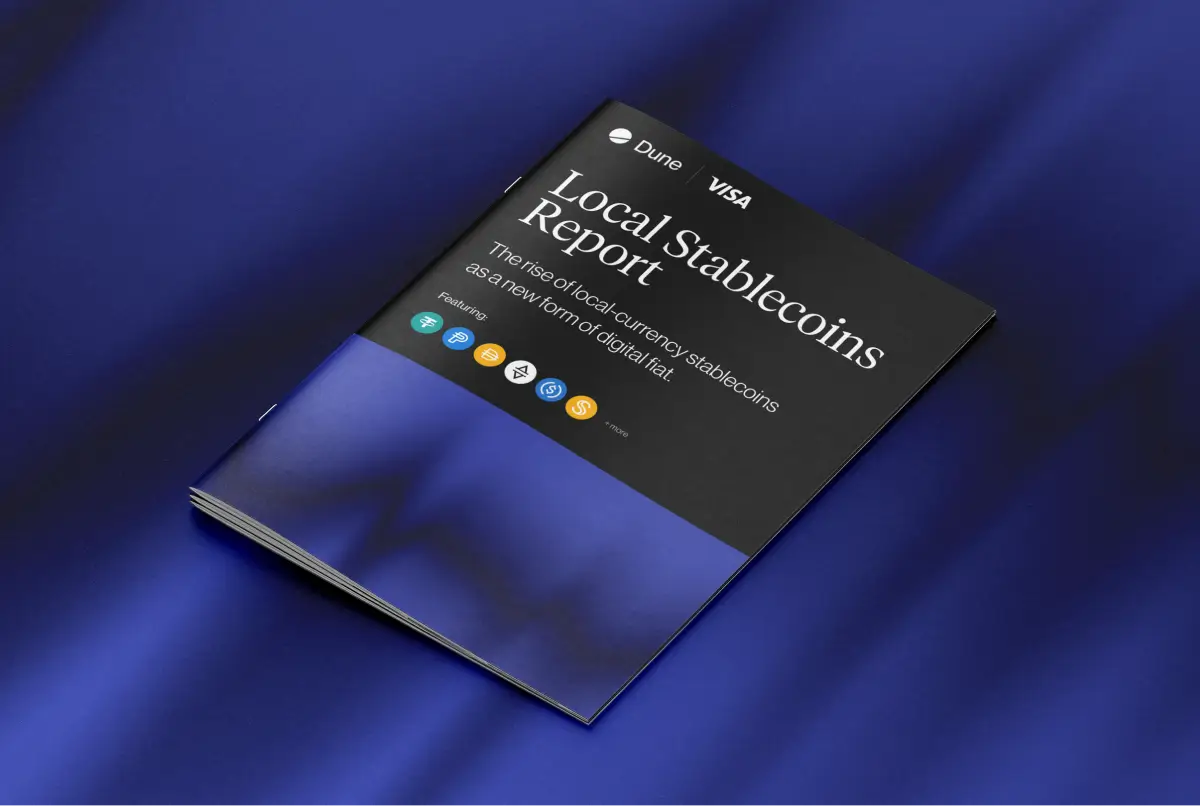
Local currency stablecoins report
Read the report
A comprehensive analysis of non-USD stablecoins covering supply, activity, holder distribution, and regional adoption. Written in partnership with Visa.